Two Sides of Modernization — Part 1
Modernization From the Software Side: Why Great Teams Still Build the Wrong Things
A strong software team can still build the wrong thing when execution begins before the organization has aligned on the problem, the decisions, the systems, and the outcome it is actually trying to achieve.
Originally published on LinkedIn on September 1, 2026.
Why great delivery teams still struggle
One thing I have learned from working in software is that a strong delivery team can still end up building the wrong thing.
Not because the team is incapable. Not because the technology is bad. And not necessarily because the requirements were poorly written.
Sometimes the real problem is that the organization moved into execution before everyone had the same understanding of what they were trying to accomplish.
By the time that disconnect becomes visible, it usually looks like a delivery problem. Requirements change. Timelines slip. Rework piles up. The client feels misunderstood and the software team feels like the target moved.
In many cases, the problem started much earlier.
Nick and I came to modernization from opposite sides of the same table.
His career taught him what it feels like to be the client—trying to translate organizational priorities, stakeholder expectations, legacy constraints, and mission outcomes into something a delivery team can execute.
My career has been spent on the other side: inside startups and software organizations building scalable products to solve complex business challenges.
Those perspectives are different, but they led us to the same conclusion: modernization rarely breaks down because people lack talent or effort. It breaks down because the organization and the software team begin delivery without a shared, durable understanding of what they are actually trying to accomplish.
What Startup Culture Taught Me
I have spent most of my career immersed in startup culture.
Startups force you to think differently about software. Time is limited. Capital is limited. Teams are often small, and every decision has consequences. You cannot afford to spend months building something only to discover that you misunderstood the problem.
That environment taught me that building software quickly is not the same as building the right software.
The strongest software teams do more than write code. They challenge assumptions, ask uncomfortable questions, test their understanding, and constantly connect what they are building to the business problem it is supposed to solve.
But even an exceptional software team can struggle when it inherits a problem that the organization has not fully defined.
Software Teams Inherit More Than Requirements
By the time work reaches a software team, the original business need may have passed through executives, program leaders, procurement teams, consultants, architects, product owners, and multiple stakeholder groups.
Each handoff introduces another opportunity for context to be shortened, interpreted, or lost.
Eventually, the delivery team receives a roadmap, a statement of work, a requirements document, or a backlog that appears complete. The work has been organized into epics and user stories. Owners have been assigned. Timelines have been established.
It looks ready for execution.
But underneath that structure, fundamental questions may still be unanswered:
- What business outcome are we actually trying to achieve?
- Do the stakeholders agree on the problem?
- Which decisions have been made, and which are still assumptions?
- Which systems should be retained, integrated, replaced, or retired?
- What dependencies could prevent the solution from working?
- How will the organization determine whether the modernization effort succeeded?
A detailed backlog can create the appearance of clarity without proving that clarity actually exists.
When those unanswered questions eventually surface, they are often treated as requirements changes, technical problems, delivery delays, or vendor performance issues. In reality, the delivery team may simply be uncovering decisions that should have been resolved before development began.
Agile Cannot Solve an Alignment Problem
Agile practices have transformed how software is delivered. They help teams break work into manageable pieces, learn through iteration, and adapt as new information becomes available.
But Agile cannot make an unresolved organizational decision.
A sprint planning session cannot determine which stakeholder has the final authority. A backlog refinement meeting cannot reconcile competing business priorities on its own. Jira and Azure DevOps can organize execution, but they cannot establish shared intent for the organization.
When alignment is missing, delivery tools can end up helping teams manage ambiguity more efficiently without actually resolving it.
The team continues moving. Stories are completed. Demonstrations are held. Progress is reported.
Then, months later, someone sees the working product and says:
“That isn’t what we meant.”
From the software team’s perspective, the requirements changed. From the client’s perspective, the delivery team misunderstood the assignment. Leadership sees missed timelines, increased costs, and growing frustration.
Usually, no single person or team is entirely at fault. The organization moved from strategy into execution without creating a reliable bridge between the two.
Moving Faster Can Magnify the Problem
One of the greatest lessons from startup culture is that speed only creates value when it is paired with focus.
Adding developers, introducing new delivery tools, or using artificial intelligence may increase the amount of work a team can produce. None of those things guarantee that the work is moving in the right direction.
In fact, the faster a team builds against unresolved assumptions, the faster the organization accumulates rework.
This becomes even more important as AI changes software development. We can now generate requirements, documentation, designs, and code faster than ever before. But AI can also produce confident answers based on incomplete or conflicting information.
If the organization has not aligned around its intent, AI does not eliminate that ambiguity. It can amplify it.
The next generation of modernization will not be defined solely by who can build the fastest. It will be defined by who can establish clarity before that speed is applied.
Two Perspectives on the Same Missing Layer
Nick experienced this challenge from the client side. I experienced what it does to the teams responsible for building and scaling software.
When we began comparing those experiences, we realized we were describing the same gap from two different directions.
Clients need a way to turn strategy, stakeholder knowledge, system constraints, and organizational decisions into something that can be confidently handed to delivery.
Software teams need more than a collection of requirements. They need to understand the intent behind the work, the decisions that shaped it, the dependencies surrounding it, and the outcomes that will define success.
That shared realization eventually became part of the foundation for STACKRYN.
We did not set out to create another project-management platform or another place to store requirements. The delivery ecosystem already has powerful tools for managing execution.
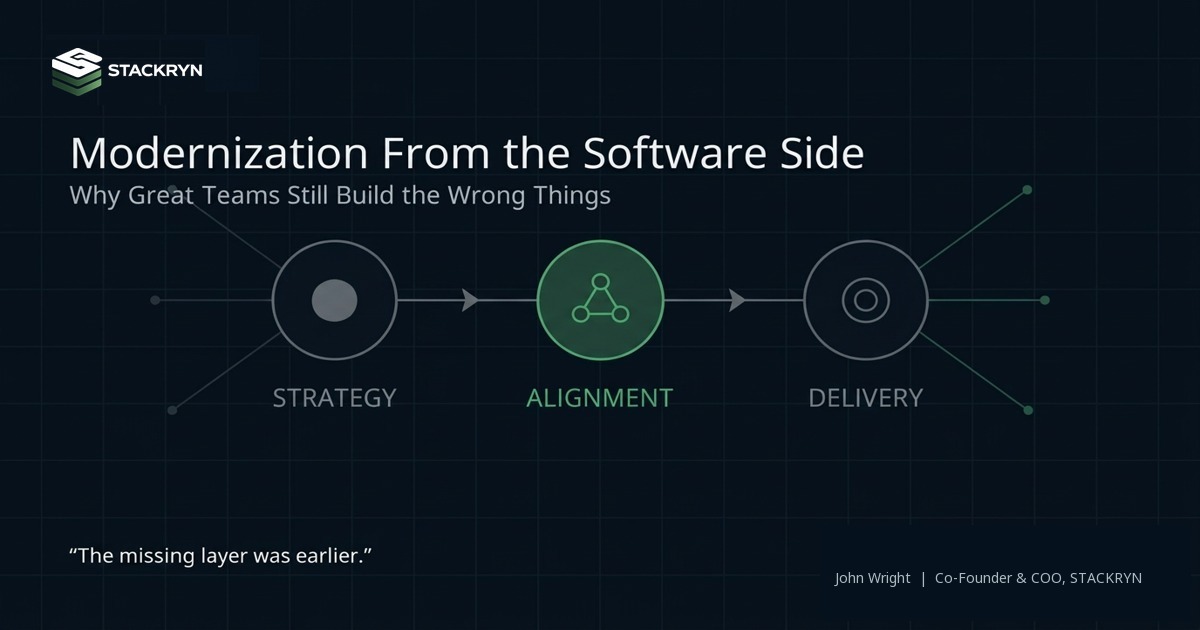
The missing layer was earlier.
At STACKRYN, we have come to think of this missing layer as alignment intelligence. It is the work of getting intent, systems, decisions, dependencies, and requirements into a shared and traceable form before the delivery team is asked to build against them.
1. Organizational Intent
- Mission / Business Outcomes
- Stakeholders
- Priorities
- Existing Systems
2. Alignment Intelligence
- Shared Intent
- System Context
- Decisions
- Dependencies
- Validated Requirements
3. Delivery
- Jira / Azure DevOps
- Product / Engineering Teams
- Build & Execute
The missing layer was earlier.
It existed between the organization’s desire to modernize and the moment a software team was asked to begin building.
Alignment Must Become Part of the Work
Alignment cannot be treated as a single workshop, a slide deck, or a document that becomes outdated as soon as delivery begins.
It must become an operational discipline.
That means capturing important decisions, exposing conflicting assumptions, understanding the existing system landscape, validating requirements with the right stakeholders, and preserving the connection between the organization’s original intent and the work that eventually enters delivery.
It does not mean waiting until every detail is perfect. Startups have taught me that perfect information rarely exists.
It means becoming clear about what is known, what remains uncertain, who owns each decision, and what must be validated before uncertainty becomes expensive.
The goal is not to slow modernization down.
The goal is to prevent organizations from moving quickly in different directions.
Modernization will always involve complexity. Priorities will change. New information will emerge. Technology will evolve.
But when the client and the software team begin with shared intent, traceable decisions, and a common understanding of success, they have something far more valuable than a perfect set of requirements.
They have a foundation they can build on.
A few things I keep coming back to
- A detailed backlog does not necessarily mean everyone is aligned.
- Jira and Azure DevOps are excellent at organizing work. They cannot resolve decisions the organization has not made.
- Moving faster against the wrong assumptions usually means creating rework faster.
- Software teams need to understand why the work exists, not just what they have been asked to build.
- Alignment has to be maintained as the work evolves, not captured once and forgotten.
This is the first article in Modernization From Both Sides, a series exploring modernization through the perspectives of the client and the software builder. Next, STACKRYN co-founder Nick Vinson will share what modernization looks like from the client side.
Align before you modernize.
STACKRYN helps organizations create a durable bridge between strategic intent and software delivery by connecting stakeholder alignment, system context, decisions, requirements, and handoff.
Related Insights
How Do Teams Stay Aligned During Complex Software Modernization?
Modernization initiatives get harder to align as more people, systems, decisions and requirements enter the picture. The challenge is not getting everyone into the same meeting. It is keeping everyone working from the same truth.
Modernization StrategyModernization Has a Memory Problem
Modernization teams have systems for execution, but far fewer for preserving the decisions, evidence and context that determine what should be executed. The result is fragmented requirements, lost institutional knowledge and a lot of institutional archaeology.
Modernization StrategyEventually, Ambiguity Is the Decision
Modernization From the Client Side — Why the Decisions Made Before Delivery Matter